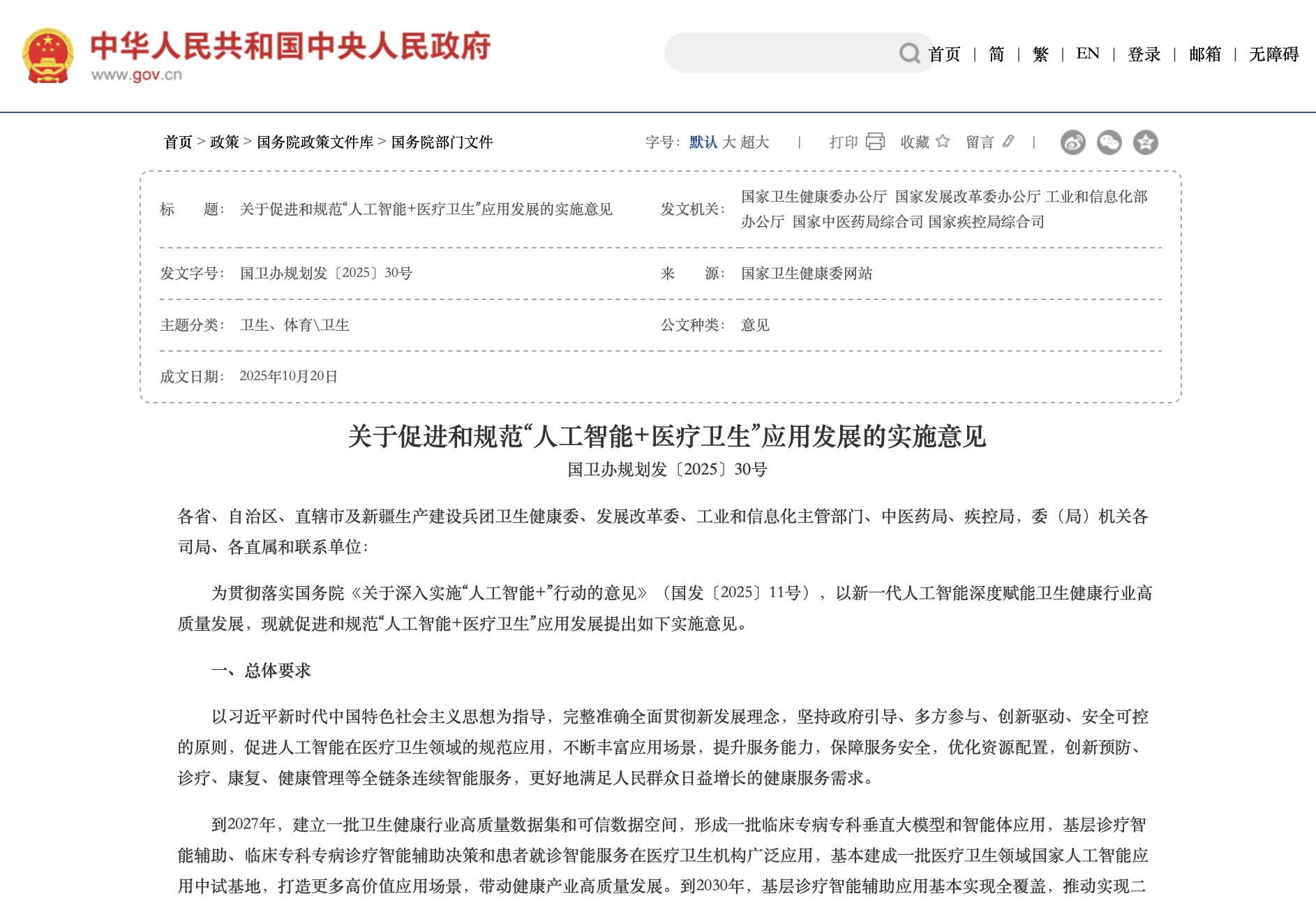
In November 2025, China's National Health Commission and four other authorities have called for the broader application of artificial intelligence (AI) in the country's health sector over the coming years.
According to a document released by all five authorities, by 2030, intelligent diagnosis and treatment assistance will be universal in basic terms across China's primary-level medical institutions, including community and village clinics. Meanwhile, hospitals at or above the second grade in China's three-tier hospital system will widely adopt AI technologies such as intelligent medical-imaging diagnosis and clinical decision-making support technologies.
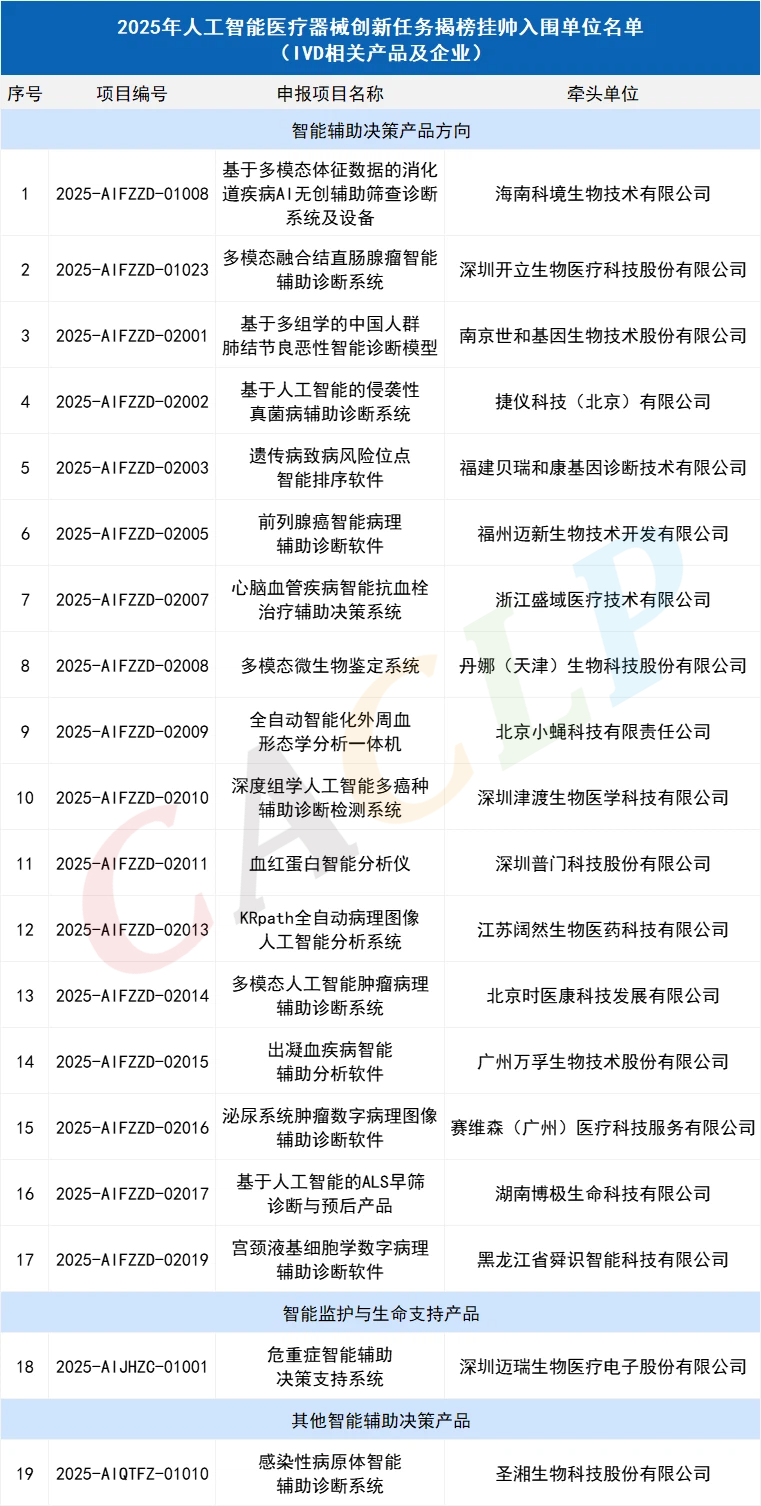
This policy direction was further reinforced in January 2026, when the Ministry of Industry and Information Technology and the National Medical Products Administration jointly announced the shortlisted entities for the 2025 “AI Medical Device Innovation Task” initiative. The announcement underscored that AI healthcare has moved well beyond conceptual hype and is now deeply embedded in core clinical scenarios, including diagnostics, primary healthcare, and drug development.
AI-Driven Diagnostic Innovation Gains Momentum
In the field of intelligent clinical decision support, a wide range of innovative products have emerged, covering high-incidence disease areas such as gastroenterology, respiratory medicine, oncology, and genetic disorders. Technologically, these solutions are characterized by multimodal data fusion and multi-omics integration.
Notable examples include:
- Hainan Kejum Bio’s Non-invasive AI-assisted Gastrointestinal Disease Screening System Based on Multimodal Vital-sign Data
- Shenzhen SonoScape’s Multimodal Colorectal Adenoma AI-assisted Diagnostic System
- Nanjing Geneseeq’s Multi-omics-based Intelligent Model for Differentiating Benign and Malignant Lung Nodules
- Fujian Berry Genomics’ Intelligent Pathogenic Risk Site Ranking Software for Genetic Diseases
- Beijing Aimagine Care Technology’s Fully Automated Intelligent Peripheral Blood Morphology Analysis System
- Shenzhen OxTium Technology’s Deep Omics AI-based Multi-cancer Auxiliary Diagnostic Testing System
- Shenzhen Lifotronic’s Intelligent Hemoglobin Analyzer
- Guangzhou Wondfo Biotech’s AI-assisted Analysis Software for Coagulation Disorders
Together, these innovations highlight the rapidly expanding AI application within China’s IVD industry.
Pathology Diagnostics as Key Breakthrough Areas
Pathology, as a core segment of the IVD industry, has emerged as a major focus area for AI empowerment. Products such as:
- Jiangsu KRGENE’s KRpath Fully Automated AI Pathology Image Analysis System
- Cells Vision (Guangzhou)’s Digital Pathology Image-assisted Diagnostic Software for Urological Tumors
According to industry data, AI-assisted pathology diagnostic systems can increase slide-reading efficiency by over 50%, providing strong technical support for primary-level medical institutions.
Intelligent Monitoring and Life-Support Systems Enter Advanced Clinical Scenarios
In this category, leading industry players have also made notable progress.
- Mindray’s Intelligent Critical Care Decision Support System successfully entered the national innovation shortlist. By integrating large-scale AI models with embodied intelligence technologies, the system breaks through traditional ICU algorithm limitations and provides comprehensive vital-sign monitoring and decision support for intensive care and emergency scenarios, demonstrating the technological depth of leading Chinese medical device companies.
- Sansure Biotech’s Intelligent Auxiliary Diagnostic System for Infectious Pathogens was categorized under other intelligent decision-support products, further enriching AI application scenarios in infectious disease prevention and control.
From Product-Level Intelligence to AI Ecosystems
An increasing number of IVD companies are accelerating the AI strategies, moving beyond individual intelligent products toward multi-layered AI ecosystems that encompass technology platforms, specialized product development and foundational model innovation.
Shinva Medical has positioned its strategy around the Huazhi Large Model, an industry-specific AI large model for medical sterilization and supply-chain management. Trained on millions of clinical data points and incorporating more than 1,200 industry standards, the model made its debut at CMEF 2025 and is now being progressively deployed. At the same time, Shinva’s AI technologies have been integrated across laboratory equipment and IVD product lines, including HbA1c analyzers and fully automated thromboelastography systems. The company is also advancing the integration of AI agent technologies into its devices, forming a full-chain empowerment model combining large models with specialized products.
Genomics AI Enters the Large-Model Era
AI-driven innovation in the genomics field is equally significant.
- Novogene has launched an AI bioinformatics expert system, Noyi, and made it freely available to customers, deeply embedding AI into genomic sequencing service workflows.
- Feipu Tech, BGI Genomics, and other research teams jointly released the world’s first genome-scale SNP foundation model - SNPBag. With 840 million parameters, SNPBag was trained on one million genome datasets and is capable of accurately identifying relationships among genetic variants. Compared with traditional tools, it delivers a 10–100× improvement in processing speed and compresses approximately six million individual SNP data points into a 0.75 MB privacy-preserving data package. This breakthrough provides revolutionary tools for rare disease screening, drug target discovery, and precision medicine, marking the formal entry of genomic research into the large-model intelligence era.
Outlook: Entering the Deep Phase of Intelligent Transformation
With sustained policy support, continuous technological breakthroughs, and increasingly diverse application scenarios, China’s IVD industry will enter a deeper phase of intelligent transformation in 2026. Looking ahead, AI will not only enhance diagnostic efficiency and precision, but also fundamentally reshape the industry’s ecosystem and ultimately deliver more efficient, accessible, and precise healthcare services worldwide.


Copyright © 2026 GL events Ruihe (Shanghai) Exhibition Co., Ltd. All Rights Reserved. ( 沪ICP备12004745号-1 )

We deliver the latest IVD news straight to your inbox. Stay in touch with CACLP News.
sign-up for our newsletter today.



To ensure our newsletter hit your inbox, make sure to add @caclp.com to your safe senders list. And, as always, feel free to contact
us with any questions and thanks again for subscribing.
 Go back